Table of Contents
- Outsourced Ecommerce Bookkeeping in Canada at a Glance
- Common Bookkeeping Mistakes Canadian Ecommerce Businesses Make
- Comprehensive Ecommerce Bookkeeping Services for Canadian Online Sellers
- When to Transition from DIY to Outsourced Bookkeeping
- GST/HST Compliance and Provincial Sales Tax for Canadian Ecommerce
Outsourced Ecommerce Bookkeeping in Canada at a Glance
Outsourced ecommerce bookkeeping in Canada gives online retailers a dedicated team handling GST/HST filing, bank and marketplace reconciliation, and financial reporting, all tailored to the Canadian ecommerce landscape. We take on these critical tasks so you gain clarity without distraction. Yet, without proper oversight, recurring bookkeeping mistakes can still creep in and affect your bottom line.
Key Takeaways
- There are a few common patterns in Canada where online sellers make reporting errors and get into tax troubles.
- A financial management service for Canadian online sellers provides sales tax compliance, real-time reporting and oversight.
- For Canadian ecommerce business owners, the decision to move from handling books themselves to engaging a professional bookkeeping service arises naturally as the business grows.
- Effective July 1, 2021, non-resident vendors and distribution platform operators (DP Os) that sell digital products and services to Canadian consumers must register and remit GST/HST.
- Transcounts charges per transaction for bookkeeping, meaning there are no surprises for our clients each month.
Common Bookkeeping Mistakes Canadian Ecommerce Businesses Make
There are a few common patterns in Canada where online sellers make reporting errors and get into tax troubles.
- Reconciling platform sales: Failing to match Shopify and Amazon sales to accounting records leads to inaccurate revenue. Integrate daily feeds to keep reports accurate.
- Poor inventory tracking: Without an integrated system, cost of goods sold and profitability get misstated. Sync inventory in real time to avoid errors.
- Neglecting GST/HST/PST: Mistimed or miscalculated sales tax filings trigger penalties. Use automated tools to stay compliant.
Recognizing these errors is the first step; the right services can help correct them.
Comprehensive Ecommerce Bookkeeping Services for Canadian Online Sellers
A financial management service for Canadian online sellers provides sales tax compliance, real-time reporting and oversight. The Canada Revenue Agency (CRA) states that sellers are responsible for record accessibility even when record-keeping is outsourced. A well-designed service ensures records are readily accessible and available for the six-year retention period.
Key components typically include:
- GST/HST/PST compliance and automated remittance,
- financial reporting and KPI dashboards integrated with Shopify, Amazon, and A2X, and
- optional fractional CFO support to guide growth.
These components work together to give sellers accurate, audit-ready records and forward-looking financial visibility. Continuous data flow eliminates the need for data entry and reduces errors. The converted back office becomes a catalyst for business expansion and growth. Rigor around compliance and reports goes hand-in-hand with what we bring to every engagement. For growing Canadian e-commerce businesses, a clear next step is to leave behind the do-it-yourself (DIY) record-keeping.
When to Transition from DIY to Outsourced Bookkeeping
For Canadian ecommerce business owners, the decision to move from handling books themselves to engaging a professional bookkeeping service arises naturally as the business grows. Recognizing the right moment to make this shift can protect profitability and free leadership to focus on scaling.
Several qualitative indicators typically signal that a professional bookkeeping service in Canada has become a practical necessity. Growing transaction volumes spread across multiple sales channels quickly make manual reconciliation a drain on productive time. Adding inventory tracking introduces layers of complexity that spreadsheets rarely handle reliably over the long term.
Increasing tax complexity is one of the clearest signals to consider this transition. Canadian sales tax obligations—including GST/HST and provincial sales tax—demand precision that goes well beyond basic bookkeeping habits.
GST/HST Compliance and Provincial Sales Tax for Canadian Ecommerce
Effective July 1, 2021, non-resident vendors and distribution platform operators (DP Os) that sell digital products and services to Canadian consumers must register and remit GST/HST. Understanding e-commerce sales tax in Canada has become increasingly critical. The Canada Revenue Agency (CRA) has a simplified registration process for qualifying non-residents, and distribution platform operators (DP Os) assume responsibility for collecting and remitting tax on vendors’ behalf. Corporations that engage in e-commerce must file Schedule 88 with their T2 income tax return to report their internet business activities. There are provincial sales taxes (PST, QST, HST) which also add to the complexity. To determine your obligations, we recommend consulting a qualified tax professional. This information is general in nature and does not replace professional tax or legal advice. At Transcounts, we integrate tools like TaxJar and Avalara to help our customers automate and simplify sales tax compliance. After establishing compliance systems, evaluating transparent and predictable professional services is the next step.
Transparent Pricing for Outsourced Ecommerce Bookkeeping Services
Transcounts charges per transaction for bookkeeping, meaning there are no surprises for our clients each month. We include sales tax compliance (GST/HST and provincial), cloud bookkeeping in QuickBooks or Xero, and direct Shopify and Amazon integrations. New clients first purchase the Financial Health Diagnostic for $99, delivered in 7 business days with a money-back guarantee. Located in Vancouver, we can build a custom quote with pricing aligned with your transaction volume and scope, meaning you’ll have pricing certainty as you begin the onboarding process.
Onboarding and Catch-Up Timeline for Ecommerce Bookkeeping
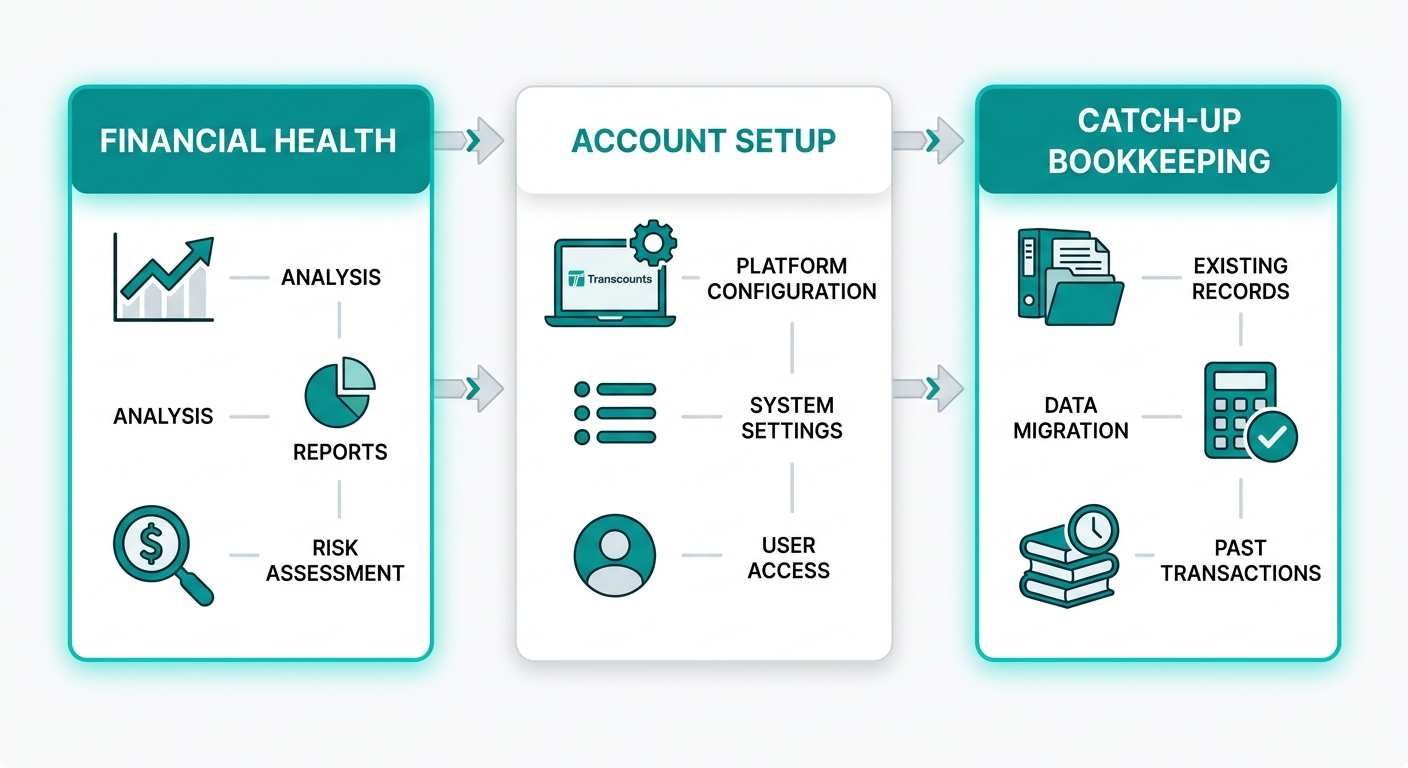
Once you choose a transparent pricing plan, our onboarding process includes a Financial Health Diagnostic to evaluate the health and priorities of your accounting processes, as well as your account setup and connections to cloud tools. We reconcile catch-up backlogs many Canadian ecommerce businesses face, bringing your books up to date. The initial Financial Health Diagnostic is delivered in 7 business days and is backed by our money-back guarantee.
Our Service Warranty and Money-Back Guarantee
We back this $99 service with a clear, upfront promise: delivery within seven business days or a full refund. This commitment addresses a top-of-mind question for ecommerce businesses in Canada exploring bookkeeping support.
Frequently Asked Questions About Ecommerce Bookkeeping in Canada
We answer common questions about outsourced e-commerce bookkeeping services in Canada, from legal requirements to transparent pricing.
What are the bookkeeping requirements for e-commerce businesses in Canada? E-commerce businesses in Canada must register for and collect GST/HST once they exceed $30,000 in taxable sales. Transcounts offers sales tax compliance services where we handle GST/HST and PST filings and keep your business compliant.
What is the cost of outsourced e-commerce bookkeeping in Canada? We provide transparent pricing based on the volume of sales transactions. Your monthly fee is based on your business activity, meaning you only pay for what you need. Reach out to us to learn more about pricing and how we can help your business.
Frequently Asked Questions
What are the most common bookkeeping mistakes Canadian ecommerce businesses make?
The most common mistakes are failing to match Shopify and Amazon sales to accounting records, poor inventory tracking that misstates cost of goods sold and profitability , and neglecting GST/HST/PST filings which trigger penalties. Sellers should integrate daily feeds, sync inventory in real time, and use automated tools to avoid these errors.
How does outsourced bookkeeping handle GST/HST compliance across different Canadian provinces?
Outsourced bookkeeping automates GST/HST compliance by integrating tools like TaxJar and Avalara to manage varying provincial rates including PST and QST. The service ensures that remittances are filed correctly, place-of-supply rules are applied, and electronic records remain accessible and audit-ready for the required six-year retention period.
When is the right time for a Canadian startup to transition from DIY bookkeeping to an outsourced service?
A Canadian startup should transition when growing transaction volumes across multiple sales channels make manual reconciliation a drain on time, inventory tracking becomes too complex for spreadsheets, or tax complexity such as GST/HST requires precision beyond DIY habits. At this point, an outsourced service protects profitability and frees leadership to scale.
How do outsourced bookkeeping services reconcile multi-channel sales from platforms like Shopify and Amazon?
Outsourced services reconcile multi-channel sales by integrating Shopify and Amazon with QuickBooks Online or Xero through A2X, which automatically matches daily sales feeds and payouts to bank records. This daily feed eliminates manual data entry, maintains accurate revenue reporting, and ensures financial records stay in sync across channels.
Get Started with Transcounts for Ecommerce Bookkeeping in Canada
We offer outsourced ecommerce bookkeeping in Canada: $99 Financial Health Diagnostic — Delivered in 7 business days — or your money back. +1(604)-332-1030 hello@transcounts.com.