Table of Contents
Key Insights into Hiring an Ecommerce Bookkeeper in Canada
Finding the right ecommerce bookkeeper in Canada is essential for navigating complex sales tax, cross-border transactions, and platform integrations. These professionals manage online sales tracking, inventory, and GST/HST compliance, freeing you to focus on growth. In this article, we’ll share key insights that will help you recognize when your ecommerce business needs a dedicated bookkeeping professional.
Signs Your Ecommerce Business Needs a Dedicated Bookkeeper
We know that appreciating a bookkeeper’s value differs from recognizing when your ecommerce business needs one.
- When your ecommerce revenue in Canada exceeds $30,000 across four consecutive quarters, the Canada Revenue Agency requires GST/HST registration and recordkeeping.
- Running distinct business models, like dropshipping alongside handmade goods, means the CRA demands a separate Form T2125 for each, complicating your books.
- You’re devoting more hours to reconciling payment gateways than to strategic growth, a sign that professional bookkeeping is overdue.
Once these signs emerge, the step is to understand what a dedicated bookkeeper handles for your online store.
What an Ecommerce Bookkeeper Does for Canadian Online Stores
We act as a bookkeeper for ecommerce business in Canada.
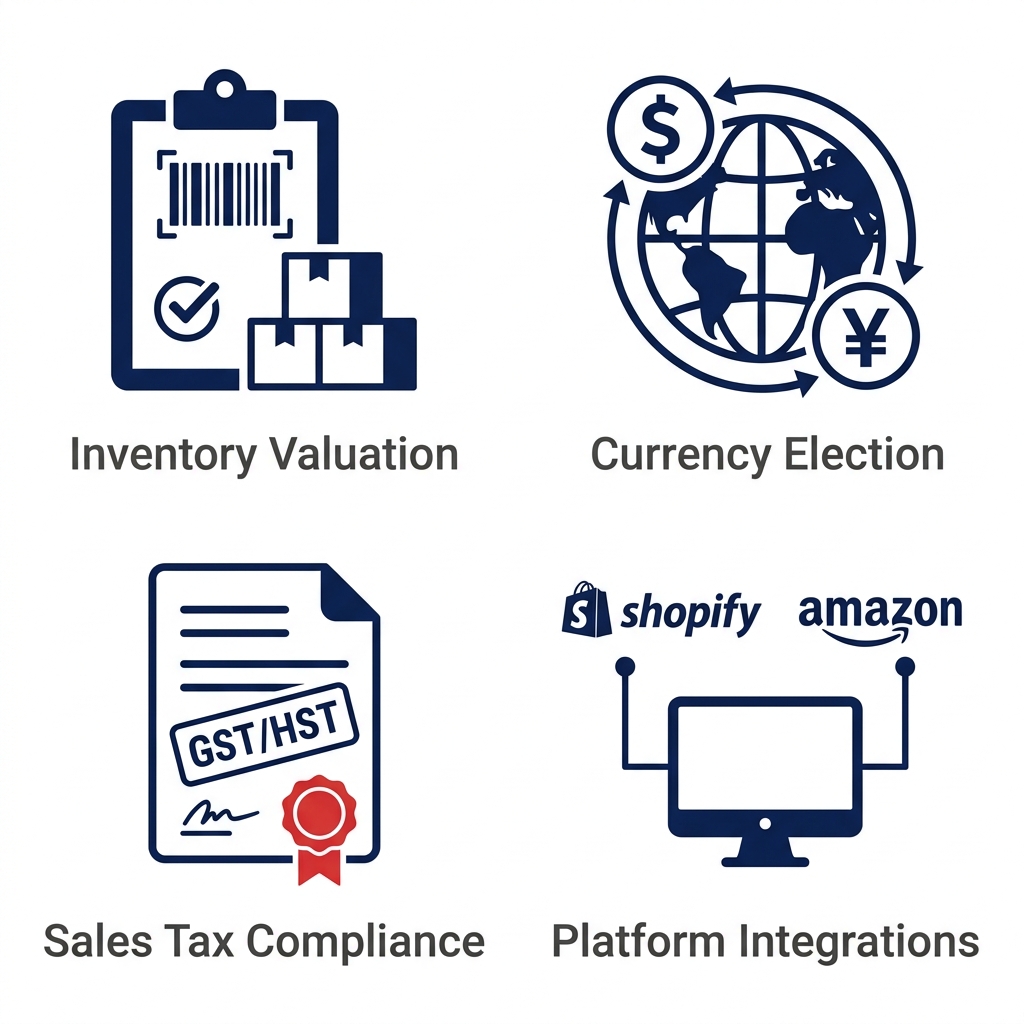
They ensure inventory is valued according to Canada Revenue Agency guidelines, using the lower of cost or fair market value method consistently each year to report cost of goods sold. When your store sells in foreign currencies, they handle the functional currency election by filing Form T1296 within the first 61 days of the tax year, using Bank of Canada daily exchange rates. They manage GST/HST/PST and U.S. sales tax compliance and integrate platforms such as Shopify and Amazon with your accounting software to automate transaction reconciliation.
These responsibilities form the core of what we deliver at Transcounts to transform their back office into a powerful growth engine.
How to Choose the Right Ecommerce Bookkeeper
Understanding what an ecommerce bookkeeper does leads naturally to how to choose the right partner for your Canadian online store. We advise focusing on these criteria:
- Ecommerce and tech fit: Seek a bookkeeper fluent in ecommerce sales channels, inventory accounting, and integrations with your tech stack, QuickBooks, Xero, Shopify, A2X, to ensure seamless data flow.
- Service breadth: Go beyond basic bookkeeping. Look for GST/HST/PST sales tax compliance, fractional CFO support for strategic growth, and KPI dashboards that give you real-time visibility into your store’s financial health.
- Transparent pricing and scalability: Choose a partner with clear, transaction-based pricing. This avoids surprises and ensures the service grows with your revenue and complexity.
Once you have the right bookkeeper, provincial compliance requirements become the next priority.
Ecommerce Bookkeeping Considerations for Every Province
After choosing a professional bookkeeper, Canadian ecommerce businesses must address several federal compliance factors that apply uniformly across all provinces.
- All peer-to-peer (P2P) ecommerce income must be reported as self-employment income on Form T2125. The Canada Revenue Agency requires a separate T2125 for each distinct business activity, even when you sell on multiple platforms.
- Digital platform operators must share seller transaction data with the CRA, and sellers who fail to provide a Tax Identification Number may face a $500 penalty per instance.
- Small suppliers with revenue below $30,000 over four quarters can voluntarily register for a GST/HST account but must stay registered for at least one year before cancelling.
These bookkeeping considerations directly influence the scope and cost of ecommerce services, and our team helps you navigate them so you can unlock strategic clarity and scale with confidence.
Understanding Ecommerce Bookkeeping Service Costs
While provincial considerations help narrow your options, understanding how a provider structures its fees is just as important. At Transcounts, we build our ecommerce bookkeeping service costs around a transparent, transaction-based fixed monthly fee model. There are no hidden fees—cost scales with your business volume. For new clients, our $99 Financial Health Diagnostic delivers a clear financial overview in seven business days, backed by a money-back promise, so you can experience our approach risk-free. Once we understand your needs, we design a tailored plan and provide an exact quote.
Once you know what you’ll pay, the next step is a smooth, hands-on onboarding process.
Ecommerce Bookkeeping Onboarding: From Start to Ongoing
Once you have clarity on pricing, the next step is getting started with our structured onboarding process. Our $99 Financial Health Diagnostic is the first step—delivered in 7 business days or your money back. We configure your dashboard, integrate your Shopify, Amazon, QuickBooks, and Xero accounts, and launch ongoing bookkeeping. After onboarding, our service guarantee backs every deliverable.
Our Ecommerce Bookkeeping Service Guarantee
Our onboarding process sets the foundation; we back it with a clear promise: the $99 Financial Health Diagnostic delivered within 7 business days, or your money back. That assurance brings peace of mind when choosing our ecommerce support.
Frequently Asked Questions About Ecommerce Bookkeeping
With our service guarantee, here are common GST/HST answers based on CRA guidelines.
When must an ecommerce business register for GST/HST? CRA requires registration when worldwide taxable revenues exceed the small supplier threshold over four consecutive quarters. You can register voluntarily.
Can you register voluntarily? Yes, but CRA requires you to remain registered for at least one year, letting you recover GST/HST on expenses.
What is ecommerce accounting and how does it matter for GST/HST? Ecommerce accounting tracks online selling transactions for accurate tax collection and remittance, while proper bookkeeping ensures compliance in Canada.
These answers prepare you to begin streamlined ecommerce bookkeeping.
Start Your Ecommerce Bookkeeping Journey
ecommerce bookkeeper in Canada, contact Transcounts to book consultation and start our $99 Financial Health Diagnostic.