
Table of Contents
Ecommerce Bookkeeping in Canada: At a Glance
Ecommerce bookkeeping in Canada requires compliance with CRA record-keeping rules: records must be reliable, complete, and accessible, with electronic records stored in a readable format and backed up. Web logs, confirmation emails and electronic signatures are required records. Businesses retain responsibility when using third-party bookkeepers, and must report loss to the CRA promptly. With these fundamentals in mind, business owners can assess whether their current bookkeeping meets the mark.
Even when you understand the basics of e-commerce bookkeeping, certain red flags, rooted in Canada Revenue Agency (CRA) standards, may signal that your online store’s record-keeping is falling short.
- Your records are not reliable, complete, and accessible for inspection, leaving you unable to substantiate tax obligations as required by the CRA.
- Electronic records that aren’t stored in a CRA-readable format or lack backup copies in Canada create a compliance gap that could trigger penalties.
- Failing to promptly report lost, damaged, or destroyed records to the CRA, and to restore the information, exposes your business to unnecessary risk.
Recognizing these warning signs is the first step toward building the essential, compliant record-keeping foundation your e-commerce business needs to thrive.
Core Components of Ecommerce Bookkeeping for Your Business
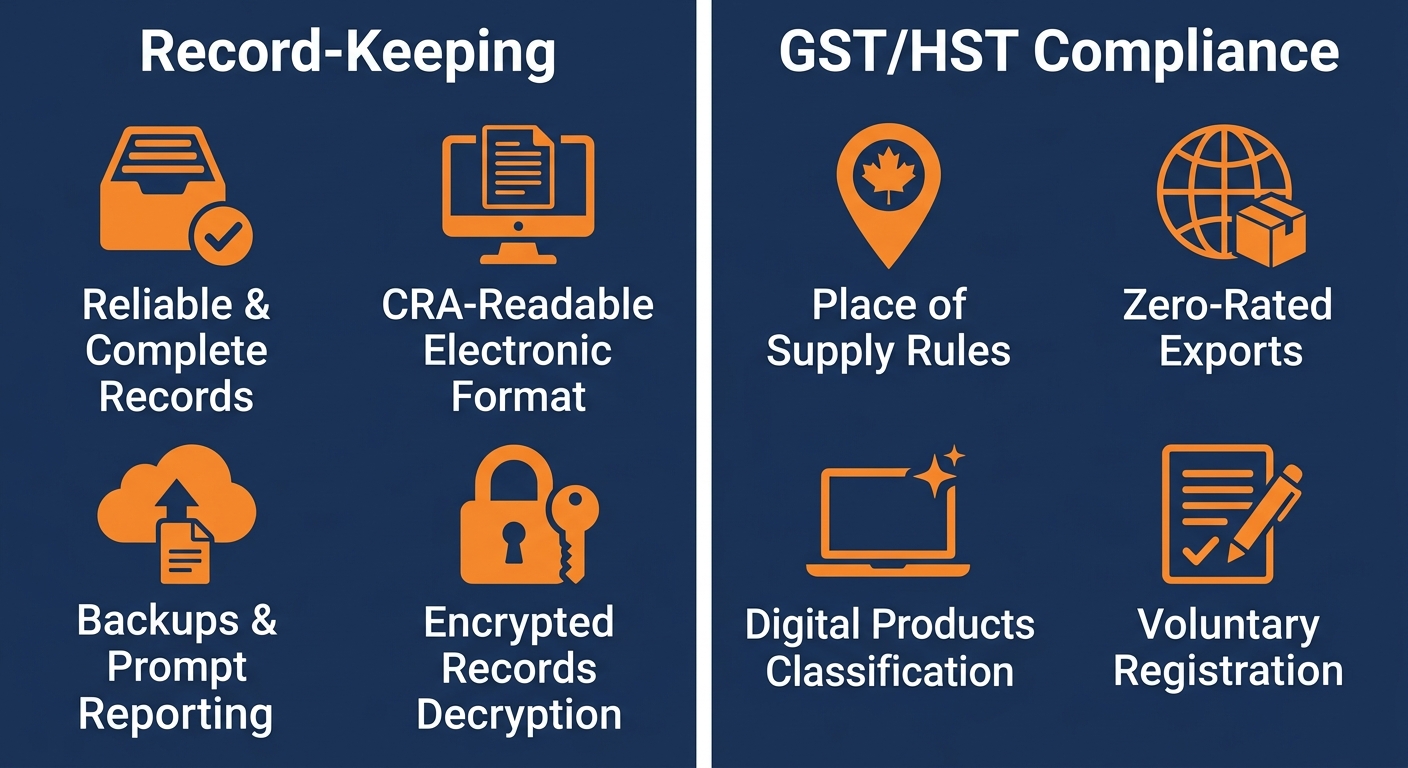
The path to reliable bookkeeping for ecommerce sellers starts with mastering two non-negotiable pillars: CRA record-keeping requirements and GST/HST compliance.
The Canada Revenue Agency (CRA) requires businesses to keep records that are reliable, complete, and accessible. This means retaining electronic transaction records, web logs, confirmation emails, and digital signatures, in a format readable by CRA software. You must also report lost or destroyed records, and maintain backup copies.
GST/HST applies to all taxable supplies in Canada; the rate depends on the place of supply—5% GST in non-participating provinces or 13% HST in Ontario. Digital products and software are treated as intangible personal property, so the same tax rules apply. Exports to non-resident customers who are not registered may be zero-rated.
With these foundational requirements in place, you can explore the most suitable bookkeeping method for your store.
Choosing the Right Bookkeeping Approach for Your Ecommerce Store
After mapping out the core components of ecommerce bookkeeping, store owners must decide how to structure the work. The choice between do-it-yourself software and a professional service hinges on how well the approach handles Canada Revenue Agency (CRA) rules. For example, digital products and software are classified as intangible personal property under CRA guidance, which affects how transactions are recorded and when GST/HST becomes due. Equally important is the ability to track the place of supply for every sale: a customer in Ontario triggers 13% HST, while a sale to a non-resident could qualify for zero-rating as an export. A bookkeeping setup that automates these calculations reduces errors and ensures accurate remittances. We structure our clients’ books to produce clean, compliance-ready records that flow seamlessly into tax filing and reporting.
Navigating Canadian Tax Compliance for Ecommerce Sellers
When choosing your bookkeeping approach, a critical piece to address is how you’ll manage Canadian e-commerce tax compliance. According to the Canada Revenue Agency, GST/HST obligations apply to taxable supplies of property and services made in Canada, and place of supply rules determine whether the 5% GST or provincial HST rate applies. Digitized products and software are classified as intangible personal property. Exports to non-residents not registered for GST/HST may be zero-rated.
Since July 2021, digital economy rules impose registration obligations on non-resident vendors and platform operators. Platform operators may collect and remit the tax from customers, shifting the burden from the supplier. Under the CRA’s digital platform reporting rules, operators collect seller identification, including Tax Identification Numbers, and report this to the CRA; sellers receive a copy by January 31, and a missing TIN can result in a $500 penalty. Operators must complete due diligence by December 31.
We recommend consulting a qualified tax professional for personalized guidance, as these rules directly influence the bookkeeping support required.
Understanding Ecommerce Bookkeeping Costs and Pricing
Given the importance of maintaining tax compliance, the costs of professional bookkeeping for Canadian online sellers vary based on several factors. Transaction volume drives the workload, while sales tax obligations such as GST/HST add complexity. According to Canada Revenue Agency guidelines, voluntary GST registration requires tracking input tax credits, which can increase bookkeeping effort and may raise service costs. At Transcounts, we use a transaction-based pricing model instead of hourly billing, giving you transparent cost predictability. Our $99 Financial Health Diagnostic, with a money-back guarantee, offers a low-risk entry point to assess your bookkeeping and compliance needs. Understanding these pricing factors sets the stage for planning a smooth bookkeeping setup that fits your business.
How Long Does Bookkeeping Setup Take?
Beyond cost, you may wonder about the time required to get your bookkeeping set up. Setup begins with our $99 Financial Health Diagnostic, delivered in 7 business days or your money back. The overall timeline depends on your transaction volume and the state of your current records. Ensuring your records meet Canada Revenue Agency requirements for reliability and accessibility may also influence the process.
Our Satisfaction Promise for Ecommerce Bookkeeping
Building on our efficient setup, our ecommerce bookkeeping services in Canada are backed by a satisfaction promise grounded in transparent processes and dedicated support. The $99 Financial Health Diagnostic, delivered within seven business days or your money back, reflects this commitment. Common questions are answered in the FAQ.
Frequently Asked Questions About Ecommerce Bookkeeping
What records does the CRA require an ecommerce business in Canada to keep?
The Canada Revenue Agency requires records that are reliable, complete and accessible for inspection.
How does GST/HST apply to online sales of physical goods versus digital products in Canada?
GST/HST follows place-of-supply rules: supplies made in Canada are subject to GST or provincial HST.
What are the GST/HST registration obligations for non-resident ecommerce businesses selling into Canada?
Since July 1, 2021, non-resident suppliers and platform operators may need to register and collect GST/HST.
Consult a qualified professional for advice specific to your situation, and once you understand these requirements, the next step is easy, reach out to us.
Get Started with Transcounts Today
Start ecommerce bookkeeping in Canada with our $99 Financial Health Diagnostic (7 business days, money-back). Contact +1(604)-332-1030, hello@transcounts.com; serving Canada and US.