
Table of Contents
Navigating Cross-Border E-Commerce Sales Tax in Vancouver
Vancouver’s e-commerce scene is booming, with local sellers expanding into international markets amid the rise of platforms like Shopify. Yet, managing cross-border e-commerce sales tax in Vancouver presents unique challenges for businesses shipping to the US and beyond. As a hub for tech-savvy entrepreneurs, the city demands savvy navigation of dual tax systems to sustain growth without costly surprises.
Key concepts include Canada’s Goods and Services Tax (GST) and Harmonized Sales Tax (HST), applied at 5% federally plus provincial rates, and British Columbia’s Provincial Sales Tax (PST) at 7% on taxable goods. For US sales, sales tax nexus rules trigger obligations once exceeding economic thresholds, such as $100,000 in sales or 200 transactions per state. According to the Small Business Guide to PST, e-commerce in BC often qualifies for exemptions on certain digital services, but physical goods shipped across borders rarely do, underscoring the need for precise tracking. Common pitfalls involve underestimating US nexus, leading to uncollected taxes and penalties for Vancouver-based operations.
Transcounts specializes in canada us ecommerce sales tax compliance, integrating tools like TaxJar for automated US filings and QuickBooks for seamless Canadian reporting. This guide explores fundamentals of cross border tax compliance vancouver, benefits of streamlined processes, step-by-step implementation, and best practices for international online sales taxation in BC. Discover how Gst Hst PST for Ecommerce Vancouver can simplify Vancouver-based cross-jurisdictional tax rules.
Start with the basics to build a compliant foundation for your e-commerce success.
Fundamentals of Cross-Border Sales Tax for E-Commerce
Navigating cross-border e-commerce sales tax requires a solid grasp of federal, state, and provincial rules, especially for sellers in Vancouver. This section explores the essentials, from Canadian GST/HST to US nexus and British Columbia’s PST, empowering businesses to handle international transactions confidently.
GST/HST Basics for Canadian Sellers
GST/HST represents Canada’s Goods and Services Tax and Harmonized Sales Tax, a value-added tax applied to most goods and services sold within the country. For e-commerce sellers, it applies at rates of 5% GST federally or up to 15% HST in participating provinces, with distinct treatments for digital versus physical products.
Registration becomes mandatory once annual worldwide revenue from taxable supplies exceeds $30,000, a key threshold monitored by the Canada Revenue Agency (CRA). For cross-border sales from Vancouver, exports of physical goods to the US are zero-rated at 0%, meaning no GST/HST is charged, though sellers must track these for compliance. Digital products, like software downloads, attract 5% GST if sold to Canadian consumers, but international sales to US buyers may qualify for zero-rating if properly documented. The CRA emphasizes that small suppliers under the threshold can voluntarily register to claim input tax credits. Key thresholds include:
- $30,000 annual revenue for mandatory registration.
- Zero-rating for exported goods and certain services.
For Vancouver sellers, understanding these rules supports smooth operations in cross-border e-commerce sales tax in Vancouver, where local digital product taxation has grown alongside the city’s e-commerce boom, with over 20% annual sector expansion. Referring to a comprehensive canada sales tax guide during registration processes ensures accurate setup. This foundational knowledge minimizes audit risks and optimizes cash flow for international growth.
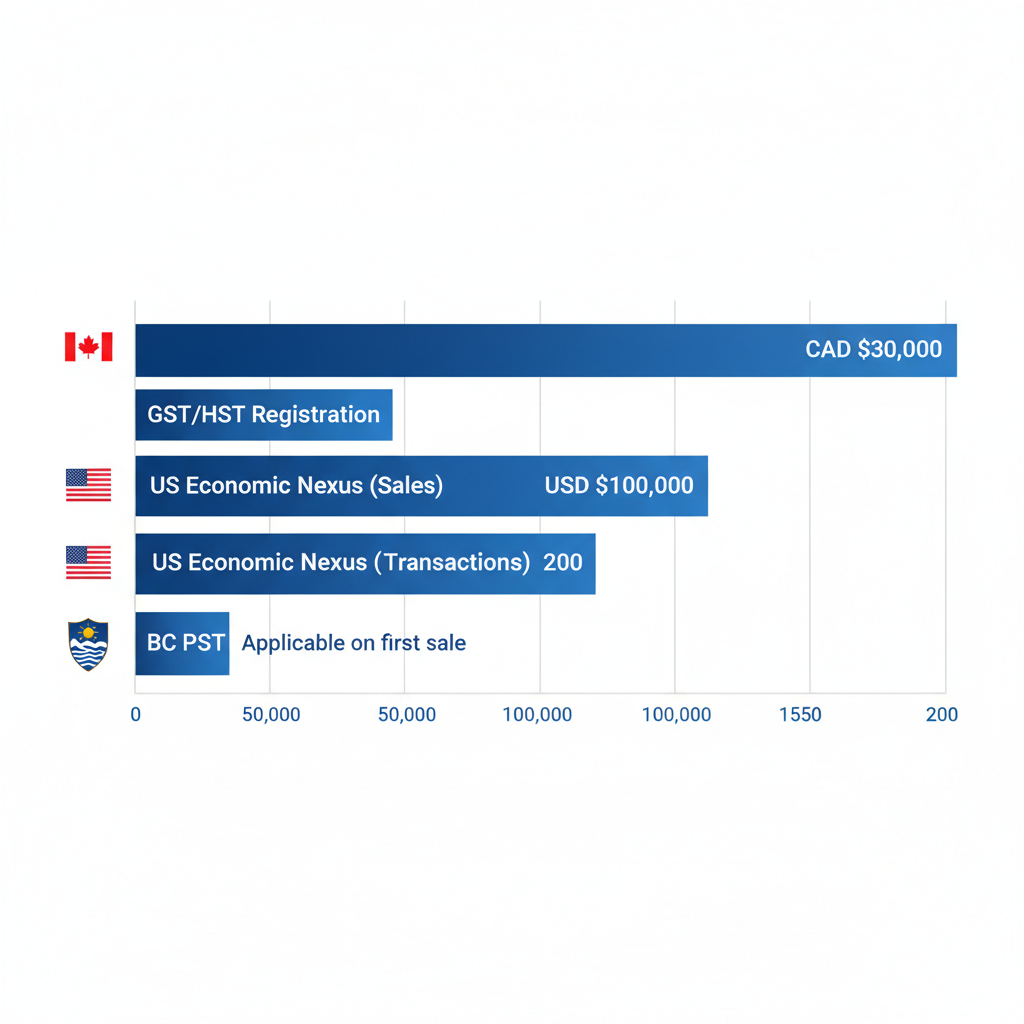
Key thresholds for cross-border e-commerce sales tax compliance
These visual thresholds highlight the varying scales businesses must monitor, from federal Canadian requirements to US and provincial levels. Vancouver e-commerce firms can use this as a quick reference to prioritize compliance efforts, particularly as cross-border volumes increase.
Understanding US Sales Tax Nexus
US sales tax nexus refers to a business’s sufficient connection to a state that obligates it to collect and remit sales tax on transactions there. For Canadian sellers, economic nexus–triggered by sales volume rather than physical presence–has reshaped obligations since the 2018 Wayfair Supreme Court decision.
Most states now impose economic nexus thresholds, such as $100,000 in annual sales or 200 transactions per state, varying by jurisdiction. For instance, California’s $500,000 threshold applies differently than New York’s $500,000 plus 100 transactions. Vancouver-based operations selling to US customers must assess nexus state-by-state; the Sales Tax Institute’s guide notes that over 45 states have adopted these rules, impacting digital goods uniformly with physical ones in many cases. An analogy: Nexus acts like a ‘tax presence trigger,’ where exceeding limits pulls a business into a state’s tax net. Examples include a Vancouver seller of apparel hitting $100,000 sales in Texas, requiring registration there. Supporting discussions on canada us ecommerce sales tax underscore the need for automated tracking tools to manage multi-state compliance.
Implications for Vancouver operations involve potential double taxation risks without proper exemptions, but certificates of resale can mitigate this. With BC-US e-commerce taxation basics driving regional trade, local sellers benefit from consulting experts to navigate these thresholds, avoiding penalties up to 25% of unpaid tax.
PST Obligations in British Columbia
Provincial Sales Tax (PST) in British Columbia is a 7% tax on taxable goods and certain services, distinct from federal GST/HST and applied at the point of sale within the province. For e-commerce, it targets local transactions, including deliveries to BC addresses, while integrating with federal taxes for comprehensive coverage.
PST applies to physical goods like electronics but exempts most digital downloads and software, unlike GST/HST. Key rules include registration for sellers with over $10,000 in BC taxable sales annually, with exemptions for exported goods to the US–no PST charged on out-of-province shipments. Integration occurs via self-assessment for combined filings, where businesses calculate both on invoices. For example, a Vancouver retailer selling furniture locally adds 7% PST atop 5% GST, but cross-border sales to Washington state skip PST entirely. Bullet points outline core obligations:
- 7% rate on tangible personal property and specific services.
- Exemptions for digital products and international exports.
- Annual registration threshold of $10,000 in BC sales.
Focusing on cross border tax compliance vancouver highlights how these rules support seamless local-international operations, especially amid the province’s 15% e-commerce growth. Vancouver international tax fundamentals like this ensure businesses avoid underreporting, fostering sustainable expansion across borders.
Advantages of Proper Tax Compliance in Cross-Border Sales
In the fast-paced world of e-commerce, proper tax compliance serves as a shield against costly setbacks. For Vancouver sellers navigating sales to the US and beyond, adherence to GST/HST and US nexus rules can prevent fines averaging $5,000 to $50,000 annually, according to CRA data. These practices not only safeguard finances but also unlock growth opportunities.
Avoiding Penalties and Audits
Non-compliance in cross-border e-commerce sales tax in Vancouver exposes businesses to significant financial and legal risks. The CRA imposes penalties up to 10% of unremitted GST/HST, plus interest, while IRS audits for US state sales tax can add 5-25% fines per jurisdiction. For instance, a Vancouver-based online retailer once faced a $10,000 CRA penalty for overlooked import duties, as outlined in the CBSA Import Guide. This real-world scenario highlights how missed filings lead to audits, legal battles, and reputational damage.
Adhering to regulations prevents these issues by ensuring accurate collections and remittances. Businesses maintain audit-ready records, avoiding disruptions that could halt operations. Numbered tiers of penalties include:
- Basic late filing: 5% of tax owing.
- Repeated offenses: Up to 10% plus daily interest.
- Gross negligence: 20-50% fines and potential criminal charges.
The benefits of BC cross-border tax adherence extend to peace of mind, allowing Vancouver entrepreneurs to focus on expansion rather than defense. By staying compliant, sellers sidestep these traps and build a stable foundation for international trade.
Enhancing Business Credibility
Compliant financial records elevate a business’s standing in competitive markets. For e-commerce operations dealing with canada us ecommerce sales tax, clean books demonstrate reliability to investors, banks, and partners. The Trade Commissioner’s Exporting Guide emphasizes that legal compliance facilitates smoother US market access for Canadian exporters, quoting enhanced trust as a key benefit that attracts funding and collaborations.
Investors scrutinize tax adherence during pitches; a Vancouver seller with impeccable GST/HST filings secured a $200,000 loan from a local bank, citing transparent reporting as the deciding factor. Partnerships flourish too, as compliant firms assure suppliers and platforms of risk-free dealings. Customers gain confidence from ethical practices, boosting loyalty in cross-border transactions.
Vancouver e-commerce compliance gains include stronger brand reputation and easier scalability. Bullet points of key advantages:
- Supports funding applications with verifiable data.
- Fosters trust-based partnerships across borders.
- Enhances customer retention through demonstrated integrity.
This credibility not only mitigates risks but empowers businesses to pursue ambitious growth strategies confidently.
Streamlining Operations and Reporting
Automation in cross border tax compliance vancouver transforms cumbersome processes into efficient workflows. For GST/HST, PST, and US nexus filings, integrated tools reduce manual entry by up to 50%, enabling faster month-end closes that save hours weekly. A Vancouver e-commerce firm reported cutting reporting time from 20 to 10 hours monthly after adopting such systems, freeing resources for core sales activities.
Professional business tax compliance services like those from Transcounts integrate with platforms such as TaxJar, automating nexus tracking and remittances across jurisdictions. This eliminates errors in multi-state US sales and ensures timely CRA submissions, minimizing administrative burdens.
Efficiency gains manifest in scalable operations, where automated alerts prevent oversights and provide real-time compliance dashboards. Vancouver sellers benefit from streamlined reporting that aligns with growth, reducing costs by 30% on average. Key operational perks include:
- Quicker filings without accuracy loss.
- Reduced need for in-house tax expertise.
- Seamless integration with e-commerce platforms.
These advancements deliver measurable Vancouver e-commerce compliance gains, positioning businesses for sustainable success in global markets.
How Cross-Border Sales Tax Compliance Works
Navigating cross-border sales tax compliance requires a structured approach for e-commerce sellers in Vancouver. This process ensures adherence to both Canadian and US regulations, minimizing risks and optimizing operations. By understanding the key stages, businesses can integrate compliance seamlessly into their workflows.
Registration and Nexus Determination
For e-commerce sellers in Vancouver, registration begins with voluntary GST/HST enrollment through the Canada Revenue Agency (CRA). This step offers input tax credits and simplifies cross-border e-commerce sales tax in Vancouver by allowing claimable refunds on business expenses. Start by gathering business details like sales volume and filing the online GST34 form via the CRA portal; approval typically takes two weeks. Next, evaluate US nexus using sales data thresholds, as outlined by the Sales Tax Institute. Track revenue per state–many require registration once exceeding $100,000 annually or 200 transactions. Tools monitor these metrics automatically.
In British Columbia, set up PST by self-assessing for out-of-province sales. Register online with the BC Ministry of Finance if your annual taxable sales surpass $10,000. Benefits include avoiding penalties and ensuring accurate pricing for customers.
Us Sales Tax for BC Shopify Sellers Vancouver provides guidance on integrating Shopify apps for nexus tracking, streamlining setup during Transcounts’ onboarding process. Common errors include overlooking remote seller rules–always verify state-specific guidelines to prevent unexpected liabilities.
Collection and Remittance Processes
Tax calculation occurs dynamically at checkout using geolocation software to identify buyer locations. For canada us ecommerce sales tax compliance, apply rates like 5% GST plus provincial portions or US state taxes based on nexus. Shopify plugins automate this, pulling real-time rates from databases and adding them to cart totals seamlessly.
Collection integrates directly into payment gateways, ensuring taxes appear as line items. Small sellers remit annually by June 30 for GST/HST, while US filings vary–monthly for high-volume states like California. BC PST follows quarterly deadlines via the ministry’s portal.
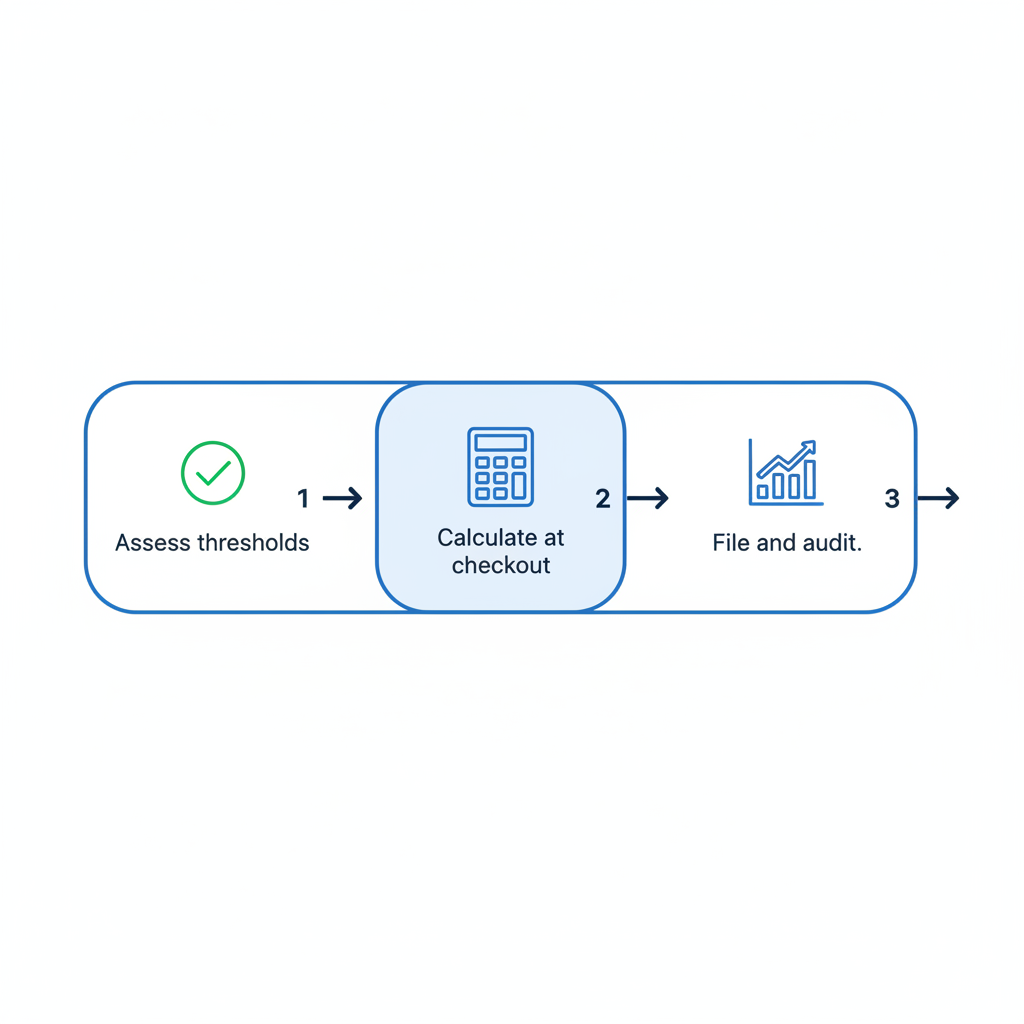
Cross-border sales tax compliance process for e-commerce sellers
This visual outlines the workflow, highlighting automation’s role in reducing manual errors. For multi-jurisdictional sales, use tools like TaxJar to consolidate collections across borders. Tip: Test checkout flows quarterly to confirm accuracy and avoid undercollection fines.
Reporting and Reconciliation
Cross border tax compliance vancouver demands monthly or quarterly filings depending on volume. For GST/HST, submit returns electronically via CRA’s NETFILE by the last day of the following month; US states require similar portals like those in Texas for combined reporting.
Reconciliation involves matching sales data with tax collected using accounting integrations. Tools like QuickBooks or Xero sync with TaxJar for automated reconciliations, flagging discrepancies early. Prepare for audits by retaining four years of records, including invoices and nexus proofs.
Vancouver sales tax filing mechanics emphasize accuracy–categorize exempt vs. taxable sales to streamline processes. Transcounts’ onboarding includes custom setups for BC cross-border remittance steps, ensuring audit-ready documentation. Warning: Late filings incur 1% monthly interest; set calendar reminders for deadlines to maintain compliance.
This foundational reporting builds toward advanced strategies, empowering sellers to scale confidently across borders.
Best Practices for Cross-Border E-Commerce Tax Management
For Vancouver-based e-commerce sellers navigating international sales, implementing robust tax management practices is essential to minimize risks and optimize operations. This section outlines key strategies focusing on automation, expert support, and vigilant oversight to achieve seamless compliance.
Automating Tax Reconciliation
Automating tax reconciliation streamlines the complex process of calculating and remitting duties on cross-border transactions. By adopting advanced Vancouver tax automation tips, sellers can reduce errors and save time.
Tools like TaxJar excel at identifying US nexus thresholds and automating sales tax collection for multi-state compliance, integrating seamlessly with e-commerce platforms. A2X specializes in Amazon seller reconciliation, matching payouts to individual orders for accurate GST/HST and provincial sales tax (PST) filings. Pair these with QuickBooks or Xero integrations for real-time bookkeeping synchronization. According to the Small Business Guide to PST from the BC government, such automation aligns with provincial requirements for digital and physical goods differentiation, ensuring remittances are filed correctly.
- Pro Tip: Integrate tools early to complete onboarding in 30 days, avoiding peak-season disruptions.
- Checklist: Assess platform compatibility, set up nexus alerts, and test monthly reports.
In Vancouver, these solutions address local nuances like PST on imported goods, enabling BC e-commerce best compliance strategies for sustainable growth. (148 words)
Leveraging Professional Services
Engaging professional services provides specialized expertise for intricate tax setups, allowing sellers to focus on core business activities.
Firms like Transcounts offer fixed-fee bundles that cover payroll, tax compliance, and ecommerce bookkeeping services vancouver bc, ensuring accurate tracking of canada us ecommerce sales tax obligations. Their services include automated remittances for GST/HST and US sales tax, with custom KPIs for performance monitoring. Clients benefit from 24-hour response times and audit-ready documentation, as seen in cases where e-commerce startups reduced filing errors by 40% through bundled integrations. Transcounts’ technology-driven model supports digital goods taxation rules, distinguishing them from physical imports subject to duties.
- Pro Tip: Customize services for seasonal sales spikes to maintain cash flow visibility.
- Checklist: Evaluate fixed-fee structures, request onboarding timelines, and align on KPI dashboards.
For Vancouver operations, this approach simplifies cross-border complexities, fostering long-term efficiency. (152 words)
Ongoing Monitoring and Updates
Ongoing monitoring ensures businesses stay ahead of evolving regulations, preventing costly penalties from outdated practices.
Conduct quarterly nexus reviews to track sales thresholds triggering registration in new jurisdictions, subscribing to CRA and IRS alerts for GST/HST and federal tax updates. Differentiate taxation for digital versus physical goods, as digital exports often qualify for zero-rating under Canadian rules. Prepare for audits by maintaining detailed records of import/export declarations. The CBSA Import Guide emphasizes real-time tracking of duty changes, while the Exporting Guide for Canadian Businesses highlights legal updates for US-bound shipments, recommending seasonal adjustments for holiday volumes.
- Pro Tip: Set calendar reminders for bi-annual law scans to adapt strategies proactively.
- Checklist: Monitor nexus via automated dashboards, archive compliance docs, and simulate audit scenarios.
In Vancouver, prioritizing cross border tax compliance vancouver through these habits safeguards against surprises in international trade. (150 words)
Achieving Compliance Success in Vancouver E-Commerce
Navigating cross-border e-commerce sales tax in Vancouver demands a strategic blend of Canadian and US regulations to ensure seamless operations. For Vancouver sellers expanding into the US market, mastering GST/HST and PST alongside nexus thresholds sets the foundation for sustainable growth. This Vancouver tax compliance summary recaps essential fundamentals, from accurate transaction tracking to timely filings, while highlighting the benefits of streamlined processes that reduce errors and penalties.
In the realm of canada us ecommerce sales tax, proactive practices like automated reconciliation tools prove invaluable, fostering efficiency and peace of mind. Cross border tax compliance in Vancouver thrives when businesses integrate these elements early, avoiding common pitfalls such as overlooked remittance deadlines. The advantages extend beyond compliance to enhanced cash flow and scalability, empowering e-commerce ventures to focus on innovation rather than administrative burdens.
Transcounts elevates this process with bundled bookkeeping, tax support, and fractional CFO services tailored for Vancouver e-commerce firms. By leveraging fixed-fee models and integrations like TaxJar, Transcounts delivers audit-ready books and strategic insights at accessible rates. For lasting success, start with a compliance audit and consult experts like an ecommerce bookkeeper surrey bc for personalized guidance.
As a final BC-US sales tax wrap-up, remember that local sellers in Vancouver thrive with integrated tools and ongoing resources, such as the Economic Nexus State Guide for US updates. Take action today to fortify your operations and drive cross-border success.