
Table of Contents
Navigating GST, HST, and PST for Ecommerce in Vancouver
For ecommerce businesses in Vancouver, mastering GST, HST, and PST for Ecommerce in Vancouver is crucial to thriving amid Canada’s layered tax landscape. As online sellers expand, compliance ensures smooth operations and avoids hefty penalties from the Canada Revenue Agency (CRA). Transcounts, a Vancouver-based firm, offers expert guidance on tax registration, calculations, and reporting, leveraging technology to keep your books audit-ready and your focus on growth.
GST, or Goods and Services Tax, is a 5% federal value-added tax applied to most goods and services across Canada, as defined by the CRA. HST, or Harmonized Sales Tax, combines federal GST with provincial sales tax in participating provinces, while PST, or Provincial Sales Tax, applies separately in British Columbia at rates up to 7% for online sales. Vancouver ecommerce sellers must charge canada sales tax rates based on buyer location for domestic and cross-border transactions, meeting British Columbia online tax obligations effectively.
Common challenges include multi-province shipping and taxing digital products, like a local artisan selling handmade jewelry online to customers nationwide. This guide covers differences between GST for ecommerce Canada and PST BC online sales, registration requirements, calculation methods, and best practices for Vancouver ecommerce sales tax compliance. Transcounts streamlines these with tailored bookkeeping services, integrating cloud tools for accurate remittances.
Understanding these fundamentals sets the foundation for confident tax management, explored further in the next section.
Key Differences Between GST, HST, and PST in Canada
For ecommerce businesses operating in Vancouver, understanding the nuances of GST, HST, and PST for Ecommerce in Vancouver is essential for seamless tax compliance and avoiding penalties. These taxes form the backbone of Canada’s sales tax system, with federal and provincial components that directly impact online sellers shipping physical and digital goods across borders. This section breaks down their structures, applications, and interactions to equip Vancouver-based entrepreneurs with the knowledge needed to navigate Canadian ecommerce tax differences effectively.
GST and HST Fundamentals for Online Sellers
GST serves as a 5% federal value-added tax applied to most taxable supplies of goods and services throughout Canada, functioning like a national toll collected at each stage of production and distribution. In contrast, HST harmonizes this federal tax with provincial sales taxes in participating provinces, creating a single rate such as 13% in Ontario, where the federal 5% blends seamlessly with the provincial portion for simplified administration.
In the realm of GST for ecommerce Canada, sellers must charge GST on taxable online sales exceeding $30,000 in annual supplies, following place-of-supply rules that determine tax based on the buyer’s location. HST applies similarly but only in harmonized provinces, requiring ecommerce platforms to adjust rates dynamically for shipments into areas like Ontario or New Brunswick. This setup ensures fair taxation on digital downloads or shipped items without double-taxing.
Consider a Vancouver online artisan shop selling handmade jewelry nationwide; it collects 5% GST on orders to non-harmonized provinces like Alberta but switches to 13% HST for deliveries to Ontario customers. Bullet points highlight key differences:
- GST is purely federal and uniform at 5%, while HST varies by province (e.g., 15% in Nova Scotia).
- Ecommerce sellers register for GST/HST once federally, easing multi-province compliance unlike separate provincial filings.
- Input tax credits recover GST/HST paid on business inputs, promoting efficiency for online operations.
PST Specifics in British Columbia
PST, or Provincial Sales Tax, stands as British Columbia’s distinct 7% levy on tangible personal property and specific services, operating independently from federal GST much like a local fee added at the point of sale within the province. Unlike GST’s broad scope, PST targets items such as vehicles, electronics, and certain repairs, exempting essentials like groceries to support consumer affordability.
For PST BC online sales, Vancouver sellers apply this tax to deliveries of taxable goods into the province, regardless of origin, with a lower $10,000 registration threshold for those establishing nexus through physical presence or significant volume. This means online businesses must track inbound shipments carefully, as software or platforms may automate rate calculations for BC-bound orders. Services like accommodation or telecom also fall under PST, adding layers for diverse ecommerce models.
Imagine a Vancouver-based digital goods seller; while PST exempts most intangibles, it taxes software installation services bundled with physical media shipped locally. Key differences in bullet points include:
- PST is provincial-only, collected separately from GST in non-harmonized BC.
- Registration kicks in at $10,000 for PST, lower than GST’s $30,000, catching smaller sellers early.
- No input tax credits for PST, increasing costs for businesses purchasing taxable supplies.
The following table compares key aspects of GST, HST, and PST to help Vancouver ecommerce sellers grasp differences in application, rates, and registration:
| Tax Type | Base Rate | Applicability to Ecommerce | Registration Threshold | Provinces Involved |
|---|---|---|---|---|
| GST | 5% federal tax on most goods and services. | Applies nationwide to taxable ecommerce sales over $30,000 CAD. | $30,000 annual taxable supplies. | Federal, all Canada |
| HST | Combined federal-provincial rate (13-15%), harmonized in participating provinces. | Applies in harmonized provinces like Ontario; ecommerce sellers must charge based on buyer location. | Same as GST, but includes provincial component. | Participating provinces (e.g., Ontario, New Brunswick) |
| PST | Provincial tax (7% in BC) on specific goods/services, separate from federal. | Applies to sales into BC; required for tangible goods and certain services. | $10,000 in BC for sellers with nexus. | British Columbia |
Data sourced from CRA and BC government guidelines for 2023 rates; rates may vary by product type. This comparison underscores how GST provides a consistent federal layer, HST streamlines in select areas, and PST adds BC-specific burdens, aiding sellers in non-harmonized regions like Vancouver to prioritize compliance tools and registrations accordingly. Mastering these distinctions minimizes audit risks and optimizes cash flow for growing online stores.
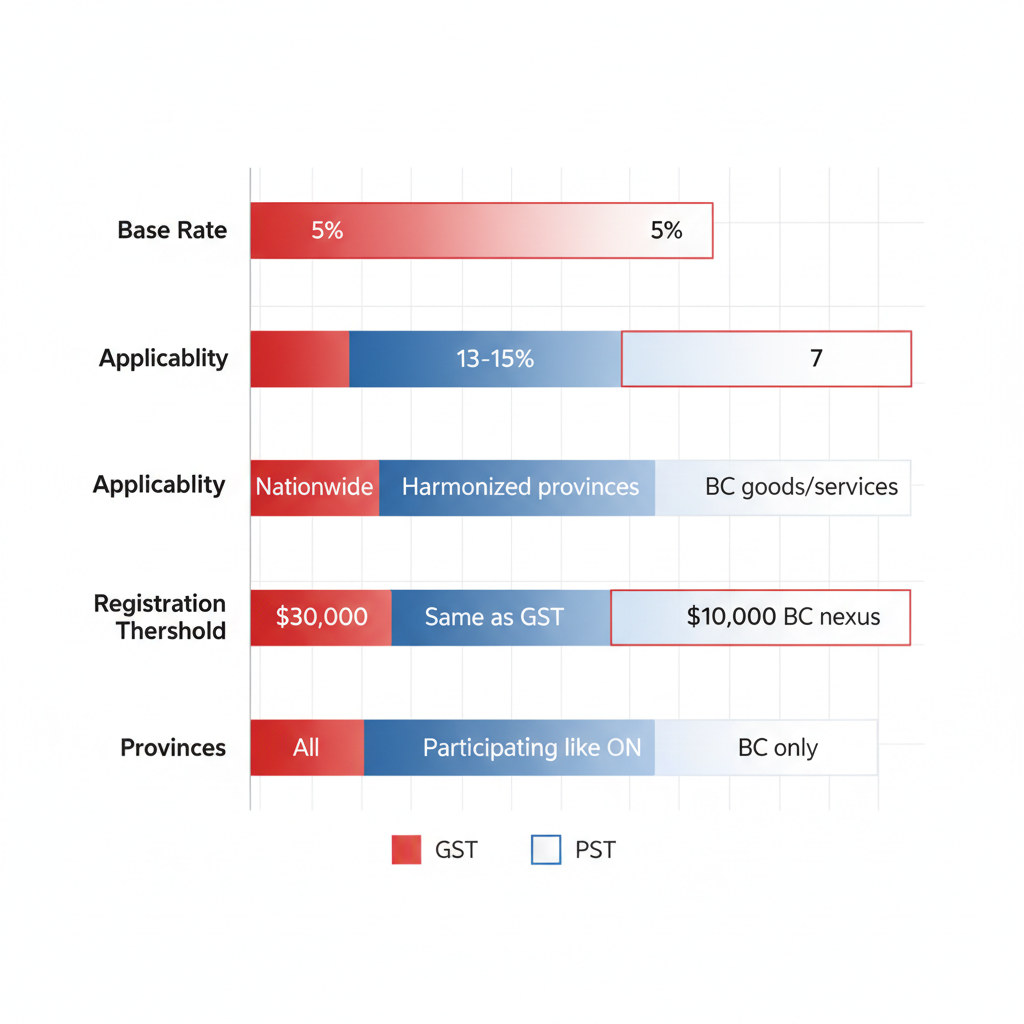
Comparison of GST, HST, and PST rates and applicability for Canadian e-commerce
The visual above illustrates rate variations graphically, reinforcing why Vancouver sellers benefit from integrated accounting software to handle these taxes dynamically across sales channels.
Overlaps and Interactions in Ecommerce Contexts
GST and HST interact with PST in non-harmonized provinces like BC, where sellers collect both federal GST and provincial PST on taxable transactions, creating overlaps for cross-province ecommerce shipments. For instance, a Vancouver business shipping to Alberta pays only GST, but local sales incur both GST and PST, with place-of-supply rules dictating the blend based on delivery location.
In ecommerce, these interactions pose compliance challenges, as sellers must determine nexus and rates for each order, especially with digital platforms automating but sometimes erring on multi-jurisdiction taxes. BC provincial sales tax for online commerce applies alongside GST for tangible goods entering the province, while HST simplifies for harmonized destinations. Input tax credits apply to GST/HST portions, but PST recovery requires separate provincial mechanisms.
A Vancouver case study involves an online clothing store with US suppliers; while handling Canadian taxes, it must also consider Us Sales Tax for BC Shopify Sellers Vancouver for cross-border nexus, layering US state taxes atop GST/PST overlaps. Bullet points outline interactions:
- Dual collection in BC: 5% GST plus 7% PST on local ecommerce sales.
- Cross-province shipping shifts to HST in Ontario, eliminating separate PST.
- Compliance tip: Use CRA-registered platforms to track thresholds and remit accurately.
By grasping these overlaps, Vancouver ecommerce operators reduce errors, ensuring smooth nationwide and international expansion while aligning with BC’s unique tax landscape.
Benefits of Proper Sales Tax Compliance for Vancouver Ecommerce
Mastering GST, HST, and PST for Ecommerce in Vancouver unlocks significant advantages for online businesses, transforming potential liabilities into strategic assets. Proper compliance not only safeguards against costly mistakes but also drives efficiency and growth, particularly for sellers navigating the complexities of GST for ecommerce Canada and PST BC online sales. By leveraging expert guidance, Vancouver online stores can focus on expansion while enjoying tax efficiency in British Columbia ecommerce.
Avoiding Penalties and Audits Through Accurate Tax Handling
Accurate tax handling shields Vancouver ecommerce sellers from severe financial repercussions, starting with the peace of mind that comes from proactive compliance. Non-compliance with GST/HST can trigger penalties up to 25% of unpaid amounts, while PST violations in BC add fines and interest that erode profits quickly.
Evidence from BC government resources highlights the risks: audits occur frequently for online sellers, with one in five small businesses facing scrutiny annually due to incomplete records. For instance, a Vancouver Shopify seller recently avoided a $15,000 penalty by maintaining detailed PST logs on taxable goods and services, as outlined in the Charge and Collect PST guidelines. Clean records prepare businesses for audits, reducing preparation time from weeks to days and minimizing disruption. Common pitfalls, like ignoring PST on services, can lead to unexpected liabilities–exemptions apply only to specific items, such as certain digital downloads, per the BC Small Business Guide to PST.
- Penalty avoidance: Steer clear of 25% fines on GST/HST errors through vigilant tracking.
- Audit readiness: Organized filings deter investigations and speed resolutions.
- Legal protection: Compliance ensures adherence to provincial rules for PST BC online sales.
This foundation of compliance advantages for Vancouver online stores directly supports smoother operations ahead.
Streamlining Operations with Tax Automation and Expertise
Tax automation revolutionizes daily workflows for ecommerce businesses, enabling faster reporting and freeing time for core activities like product development. Integrating tools such as Xero automates GST/HST calculations and PST remittances, cutting manual errors by up to 80%.
Practical benefits shine in real scenarios: a BC-based digital goods seller reclaimed 13% input tax credits on software expenses, boosting cash flow by $5,000 annually, as guided by provincial small business resources. Automation handles exemptions seamlessly–for example, zero-rating exported supplies–while expert services like those from Transcounts ensure accurate filings. This setup addresses questions like whether to charge PST on taxable goods sold in BC, confirming yes for most physical items unless exempt, per official guidelines. The result? Month-end closes in hours, not days, with integrated platforms flagging discrepancies early.
- Efficiency gains: Automated calculations reduce processing time dramatically.
- Cost recovery: Reclaim credits on business inputs for immediate savings.
- Error reduction: Tools prevent oversights in GST for ecommerce Canada.
These operational boosts pave the way for scalable growth without the drag of manual tax tasks.
Enhancing Business Growth and Credibility
Compliant tax practices build lasting trust with customers and investors, positioning Vancouver sellers for accelerated expansion in competitive markets. Strong financials signal reliability, attracting partnerships and funding opportunities.
Consider a case study: a Vancouver-based physical goods ecommerce firm, using proper compliance, secured $200,000 in venture capital after presenting audit-ready reports that highlighted tax efficiency in British Columbia ecommerce. Investors value businesses that manage Cross Border Ecommerce Sales Tax Vancouver effectively, enabling international sales without compliance hurdles. This credibility extends to customers, who prefer transparent sellers adhering to PST BC online sales rules, fostering loyalty and repeat business. Beyond growth, it unlocks strategic perks like simplified reporting for loans, turning tax knowledge into a competitive edge.
- Investor appeal: Clean records facilitate funding and partnerships.
- Customer trust: Ethical compliance enhances brand reputation.
- Scalable expansion: Supports cross-border ventures seamlessly.
Embracing these benefits sets the stage for implementing compliant strategies in daily ecommerce operations.
Calculating and Registering Sales Taxes for BC Ecommerce Sellers
Vancouver ecommerce sellers must navigate GST, HST, and PST for Ecommerce in Vancouver to ensure compliance while scaling their online businesses. Understanding these taxes helps avoid penalties and streamlines operations for sellers handling nationwide orders from British Columbia. This section outlines the key processes for registration, calculation, and integration, providing practical steps tailored to BC-based online stores.
GST/HST Registration and Calculation Methods
For GST for ecommerce Canada, businesses reach the $30,000 annual sales threshold. Begin BC ecommerce registration steps by logging into the CRA online portal at canada.ca. Create an account if needed, then submit your business details, including GST number application. Approval typically takes about five business days. Once registered, calculate taxes using place-of-supply rules: apply 5% GST nationwide or provincial HST rates, such as 13% in Ontario.
To compute tax-exclusive amounts, use the formula: tax = price × rate. For tax-inclusive, divide: price = total / (1 + rate). For a $100 Vancouver online sale to an Ontario buyer, apply 13% HST: tax = $100 × 0.13 = $13, making the total $113. Common errors include ignoring buyer location; always verify province to apply correct rates. Remit monthly if sales exceed $50,000 quarterly or quarterly otherwise via CRA’s My Business Account.
Tips include using CRA’s GST/HST calculator tool for accuracy and consulting official guidelines from the Charge and Collect GST/HST Rates resource to stay updated on thresholds.
Common scenarios for ecommerce sales illustrate these calculations. The table below shows examples based on 2023 rates for typical transactions, highlighting how place-of-supply rules affect GST/HST and PST application. Actual results depend on CRA and BC guidelines.
| Transaction Type | Buyer Location | GST/HST Rate | PST Rate (if BC) | Total Tax |
|---|---|---|---|---|
| Physical Goods Sale | Ontario (HST province) | 13% HST = $13 ($100 Shirt) | N/A | $13 Total Tax |
| Digital Download | BC (PST province) | 5% GST = $2.50 ($50 E-book) | 7% on $50 = $3.50 | $6 Total Tax |
| Cross-Province Shipping | Alberta (GST only) | 5% GST = $10 ($200 Electronics) | No PST for AB delivery | $10 Total Tax |
These examples demonstrate varying tax burdens: Ontario sales incur higher HST, while BC digital products add PST, increasing totals by up to 12%. Alberta shipments avoid provincial taxes, benefiting cross-border efficiency. Vancouver sellers should audit orders monthly to apply these correctly, reducing compliance risks and optimizing cash flow.
PST Processes for Online Sales in British Columbia
PST BC online sales require registration if your BC sales exceed $10,000 annually. Visit the BC government’s PST registration portal at gov.bc.ca to apply online, providing business license and sales projections. Nexus establishes if you store inventory in BC or make local deliveries. Once approved, collect 7% PST on taxable items like physical goods and certain digital products.
For tax calculation for Vancouver online sales, apply PST post-GST: total tax = GST + (price + GST) × 0.07. On a $100 physical item sold in BC, first add 5% GST ($5), then 7% PST on $105 ($7.35), totaling $12.35 tax. Exemptions cover zero-rated digital services like software updates but not e-books. Place-of-supply mandates PST only for BC deliveries or services.
Remit PST monthly or quarterly based on volume through the Ministry of Finance portal. Avoid pitfalls like overlooking digital taxability; reference the Charge and Collect PST bulletin for exemptions lists. Automation flags taxable items during checkout to simplify collections.
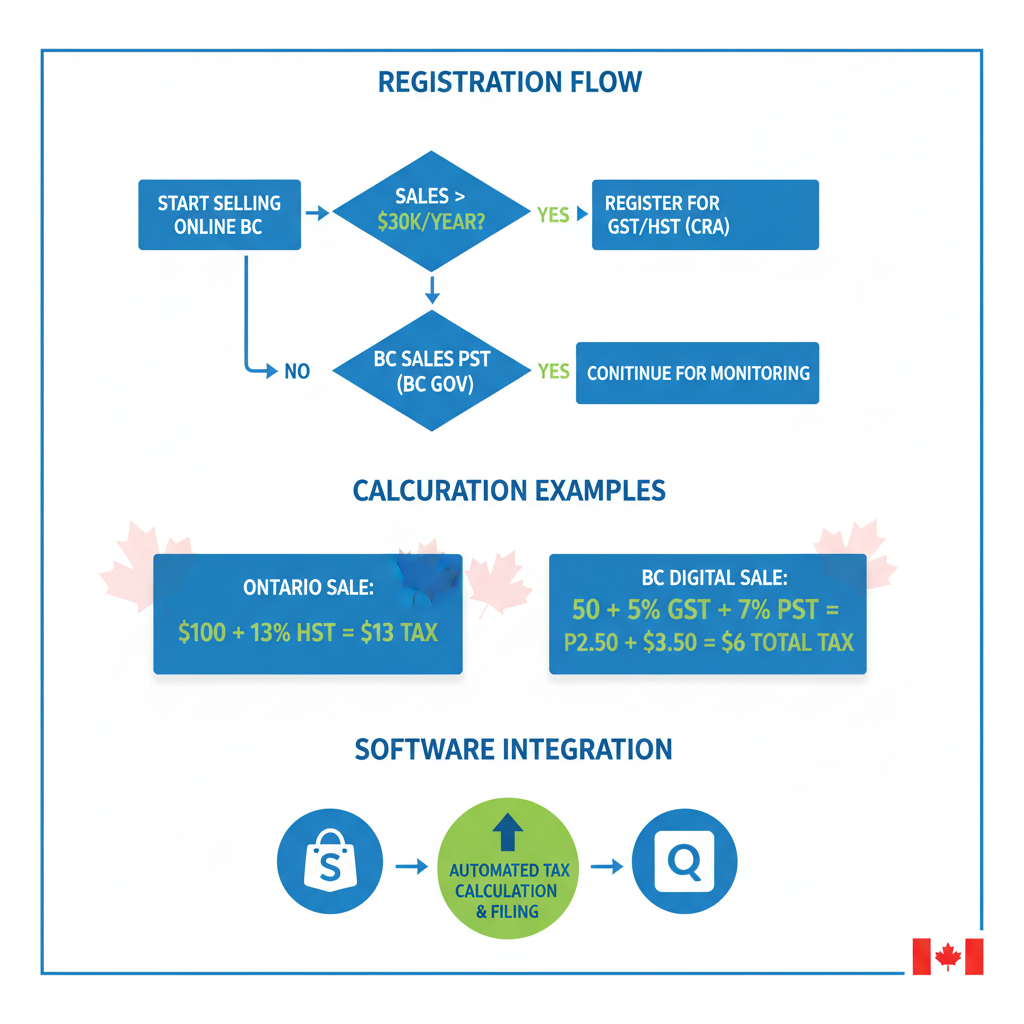
Sales tax calculations and registration guide for Vancouver ecommerce businesses
This visual aid reinforces the sequential processes, helping sellers visualize workflows from registration to remittance while ensuring accurate application across product types.
Integrating Taxes into Ecommerce Workflows
Streamline multi-tax compliance by connecting platforms like Shopify to tax software. For Vancouver ecommerce, set up automated rules for GST for ecommerce Canada and PST BC online sales during checkout, pulling rates based on buyer addresses.
Implement steps: 1) Integrate CRA and BC APIs via tools like TaxJar for real-time calculations. 2) Map place-of-supply logic to auto-apply 5% GST or 7-15% HST/PST. 3) Generate remittance reports quarterly. For a $100 order, the system computes and withholds taxes seamlessly, reducing manual entry errors.
For cross-border needs, consider sales tax compliance canada us solutions that handle US nexus alongside Canadian rules, ideal for expanding Vancouver sellers. Tips: Schedule weekly reconciliations and use cloud backups for audit trails. This integration not only ensures accuracy but positions your business for growth beyond basic compliance.
While these calculations form the foundation, ongoing strategies in best practices ensure sustained efficiency and adaptability to tax changes.
Best Practices for GST, HST, and PST Compliance in Vancouver Ecommerce
Vancouver ecommerce businesses must adopt proactive compliance strategies for GST, HST, and PST for Ecommerce in Vancouver to avoid penalties and streamline operations. Beyond basic calculations, these practices ensure accurate tracking, timely filings, and scalable growth for online sellers in British Columbia. By focusing on automation, vigilance, and expert guidance, sellers can minimize risks while maximizing efficiency.
Implementing Robust Tax Tracking Systems
Robust tax tracking forms the foundation of GST for ecommerce Canada, enabling seamless integration with sales platforms. For BC sellers handling PST BC online sales, reliable systems prevent discrepancies during high-volume periods.
To build effective monitoring, start with automated tools that sync directly with your ecommerce backend. Integrate solutions like A2X with QuickBooks to calculate GST/HST and PST in real-time, reducing manual entry errors by up to 80 percent according to industry benchmarks.
- Good Practice: Conduct monthly reconciliations to match sales data with tax ledgers, using segregated records as recommended in the BC Small Business Guide to PST for audit readiness.
- Poor Practice: Relying on spreadsheets alone, which often leads to overlooked adjustments and compliance gaps.
- Pro Tip: Set up automated alerts for threshold breaches, ensuring nexus rules for interprovincial sales are flagged early.
- Best Step: Export transaction reports weekly to verify rates, aligning with CRA guidelines for accurate remittances.
In Vancouver, where digital product sales are booming, these systems help local sellers like tech startups maintain compliance without disrupting daily workflows. This approach supports advanced BC tax management for sustainable expansion.
Staying Updated on Tax Changes and Exemptions
Staying informed on evolving regulations is crucial for compliance strategies for Vancouver sellers, particularly with frequent adjustments to GST/HST rates and PST exemptions. Proactive monitoring safeguards against surprises in online transactions.
Subscribe to official CRA and BC government alerts via their GST/HST Registration Menu and provincial bulletins to receive timely notifications on policy shifts. Regularly review these sources to adapt your processes, quoting CRA’s advice: “Businesses should check for updates quarterly to ensure ongoing compliance.”
- Good Practice: Leverage exemptions for exported goods and certain digital services, documenting claims with detailed invoices to optimize refunds.
- Poor Practice: Ignoring exemption criteria, resulting in overpaid taxes and reduced profit margins.
- Pro Tip: Use a dedicated calendar for rate change reminders, integrating them into your CRM for automated client notifications.
- Key Action: Attend free webinars from BC tax authorities to deepen understanding of PST rules for intangible property.
A Vancouver nonprofit ecommerce operation, for instance, saved thousands by claiming exemptions on educational digital downloads after subscribing to BC alerts. This vigilance not only ensures compliance but also enhances financial health for businesses in BC.
Partnering with Experts for Seamless Management
For complex scenarios like multi-jurisdictional nexus, partnering with specialists streamlines GST, HST, and PST management in Vancouver ecommerce. Experts provide tailored support to navigate audits and automate filings effectively.
Engage firms experienced in ecommerce tax compliance to handle reconciliations and reporting. Services like ecommerce bookkeeping services vancouver bc offer audit-ready documentation and integration with tools such as TaxJar, ensuring accuracy for cross-border sales.
- Good Practice: Outsource monthly closes to professionals who segregate records per the BC Small Business Guide, freeing time for core business activities.
- Poor Practice: Managing everything in-house without expertise, leading to errors in exemption claims and delayed remittances.
- Pro Tip: Select partners with CRA-certified staff for reliable advice on PST BC online sales thresholds.
- Essential Step: Schedule quarterly reviews with experts to align tax strategies with growth goals.
In Vancouver’s competitive market, businesses partnering with local firms like Transcounts achieve faster month-end processes and reduced audit risks. This collaboration paves the way for long-term success, allowing sellers to focus on innovation rather than compliance burdens.
Ensuring Ongoing Tax Compliance for Vancouver Ecommerce Success
Navigating GST, HST, and PST for Ecommerce in Vancouver demands vigilance to sustain business growth. As a federal baseline, GST applies nationwide at 5%, while HST harmonizes it with provincial rates in select areas, and PST BC online sales add a 7% layer for British Columbia transactions. Sellers must register once hitting $30,000 in worldwide sales or $10,000 for digital goods, ensuring accurate calculations on every invoice to avoid penalties and maintain cash flow.
Key Takeaways for Sustainable Tax Strategies in Vancouver: Prioritize timely filings to claim input tax credits, reducing effective costs. Implement automated tools for tracking nexus thresholds, as outlined in official guides like the GST/HST Glossary for clear definitions and the Charge and Collect GST/HST Rates resource emphasizing rate updates. For GST for ecommerce Canada, focus on cross-border rules; for PST BC online sales, verify provincial exemptions. This BC ecommerce compliance recap underscores how proactive practices shield against audits, fostering efficiencies that let businesses like a local Vancouver apparel shop scale from startup to regional leader without tax disruptions.
Empower your operations by adopting these best practices today. For tailored support in Vancouver ecommerce tax needs, connect with Transcounts. Our experts deliver cleaner books, seamless compliance, and growth-ready finances through fixed-fee services integrated with tools like QuickBooks and Xero. Reach out now to transform challenges into opportunities for lasting success.